

Natural Materials & Finishes
Why a Straw Bale House Shouldn't Be Rendered with Cement Plaster
Why cement render is risky on straw bale walls: the difference in vapor permeability between cement, lime and clay plasters, and how trapped moisture can lead to straw rot.
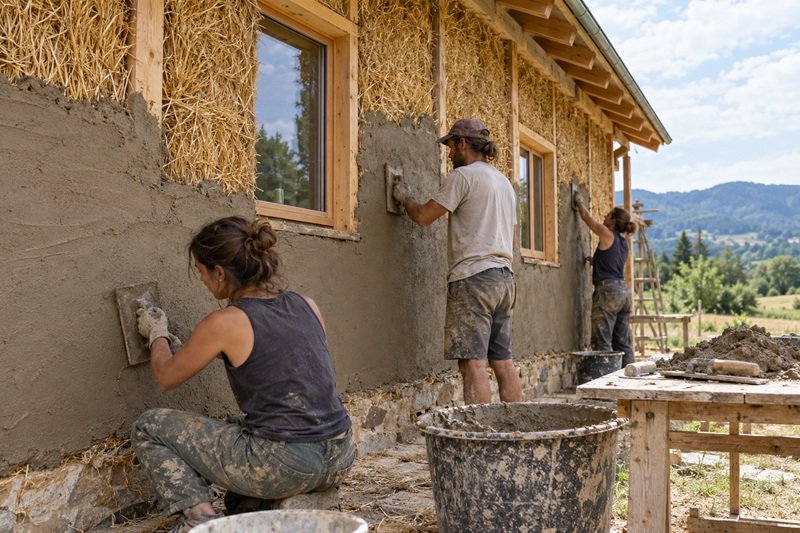
Straw actually has excellent adhesion, so almost any plaster will go on and bond well.
Today, though, we'll look at the main types of render used on straw bale homes: cement, lime (including cement-lime), and clay.
«AI-generated visualization of the process. Not a photograph of an actual Eco-Bud project».
Some people mistakenly believe clay isn't strong enough for a straw bale house, so to reinforce the walls they decide to render the house with cement plaster.
At first glance everything looks fine — the house is well protected from the weather. So where's the danger?
The issue is that clay render, like lime render, is highly permeable to water vapor and doesn't hold moisture inside the wall for long. For comparison, a tested 1:3 cement:sand stucco sample, 43.5 mm thick, measured 0.68 US perms — from earlier testing by Straube (2000), as cited in the Straube (2003) report. A cement-sand render like that, the report notes, behaves almost like a vapor barrier.
To explain the difference more precisely, it's better to talk not about everyday "hydrophilicity" but about a material's vapor permeability — its ability to let water vapor pass through. Clay and lime have high vapor permeability; the tested cement-sand mixes are much lower. Porous mineral plasters in general can also temporarily hold some moisture and release it gradually as they dry (so-called hygroscopic buffering), but the key difference between these mixes is vapor permeability itself.
What does this mean in practice? If vapor entering from inside or outside the house can't pass freely through the render, it condenses and gets trapped right in the straw. Damp straw eventually grows mold and mildew, and can ultimately begin to rot.
Now the second question: where does moisture in the wall even come from if it's properly rendered?
Water vapor moves by diffusion, from areas of higher partial vapor pressure to areas of lower partial vapor pressure. The direction of this movement depends on the temperature and humidity on each side of the wall and can change over the course of the year. Showers, cooking, houseplants and people's breathing raise the moisture content of the indoor air; given a suitable difference in partial pressure, this can create a flow of water vapor from the room into the wall.
If the wall is rendered with clay or lime, the render's high vapor permeability leaves this moisture a way to gradually work its way back outward as the wall dries.
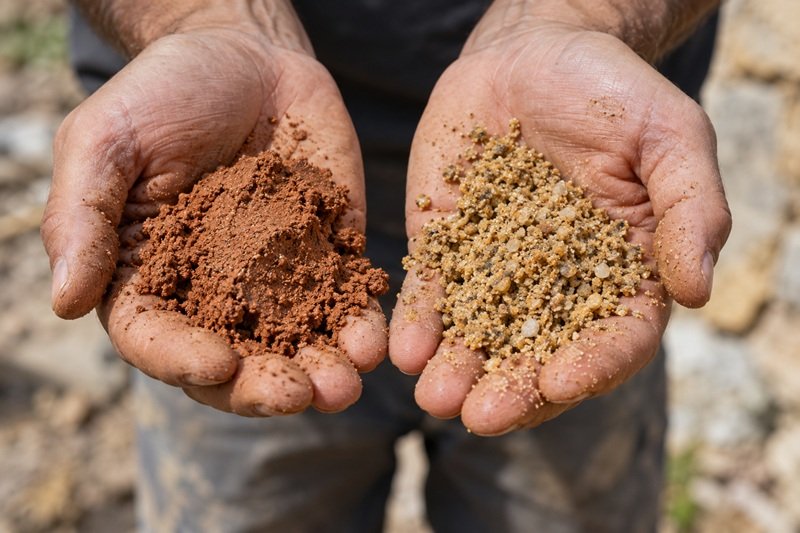
«AI-generated visualization of the process. Not a photograph of an actual Eco-Bud project».
Low vapor permeability in the finish layer can limit how well the wall is able to dry out. The actual risk depends on the plaster's composition and thickness, the moisture sources involved, the climate, and the wall assembly as a whole.
The building's operating conditions matter too. In a wet climate, or where walls face heavy driving rain, the risk of moisture buildup is higher, and the render's vapor permeability becomes especially critical. In a dry, hot climate, the same cement layer can behave differently. The wall assembly as a whole matters too, but that doesn't mean every straw bale wall needs its own vapor-control layer or ventilation gap — the right combination depends on the specific climate and project. Roof overhangs that shield the walls from direct rain are generally useful in most cases, though.
It's also worth noting that adding lime to a cement render noticeably increases its vapor permeability — even a small amount of lime can substantially improve how well the render "breathes." That's why a pure cement mix and a cement-lime mix behave quite differently on a straw bale house.

«AI-generated visualization of the process. Not a photograph of an actual Eco-Bud project».
The conclusion, then: because of these differences in vapor permeability, straw bale walls are not recommended to be rendered with pure cement-based mixes — over time this can lead to moisture buildup and straw rot.
Clay render, like lime render, remains the healthier, more affordable and easier-to-work-with choice — one that reliably protects straw bale walls from destructive moisture, provided the rest of the wall assembly and the local climate are also accounted for correctly.
Source for the technical vapor-permeability data: Straube, J. "Moisture Properties of Plaster and Stucco for Strawbale Buildings" (Ecological Building Network, 2003). Full report (PDF).
NEXT STEP
Planning a healthy, energy-efficient home?
Tell us about your site, your ideas and the home you want to build. We will help you identify the right next step.